In 2006, African leaders gathered in Abuja around a problem that was clear and urgent: African farmers were using too little fertilizer.
The Africa Fertilizer Summit, held in Abuja that year, resulted in the Abuja Declaration, which called for fertilizer use across the continent to increase from an average of about 8 kilograms per hectare to at least 50 kilograms by 2015.
Two decades later, fertilizer use has increased, but the challenge has changed. Rates have risen to around 20–25 kilograms per hectare in Sub-Saharan Africa, according to Dr Bernard Vanlauwe (as reported in African Fertilizer Dashboard), but fertilizer-use efficiency remains poor. At the same time, declining soil health has become increasingly central to the continent’s agricultural agenda.
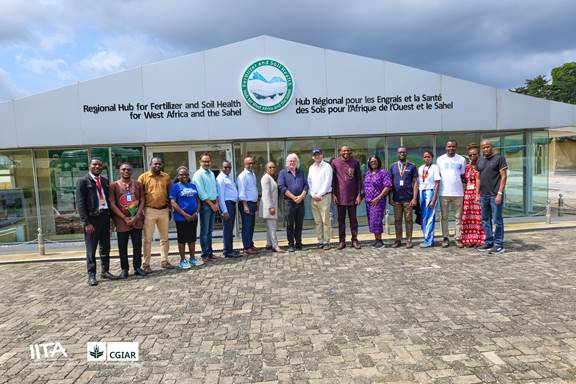
That evolution was at the heart of a presentation by Dr Bernard Vanlauwe, Deputy Director General for Research for Development at the International Institute of Tropical Agriculture (IITA), during the visit of CGIAR Council Chair Renaud Seligmann to the Regional Hub for Fertilizer and Soil Health for West Africa and the Sahel at IITA’s headquarters in Ibadan.
The visit, which took place on 25 September 2026 during the CGIAR Board meetings in Ibadan, offered an opportunity to trace how a continent-wide call for more fertilizer has evolved into a more integrated focus on fertilizer-use efficiency, soil health, data-driven recommendations, technical capacity and country-led implementation.
From fertilizer access to fertilizer-use efficiency
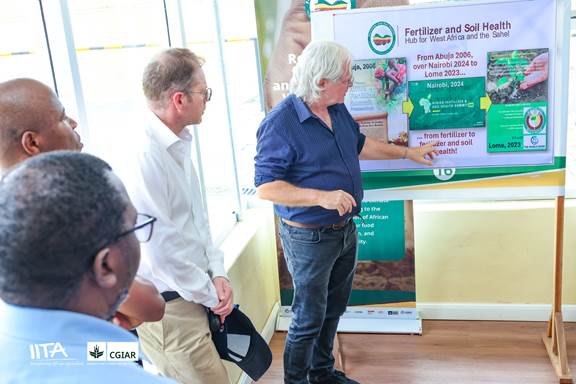
The Abuja Summit marked an important turning point in Africa’s fertilizer agenda. Its central concern was increasing access to and use of fertilizer to address low agricultural productivity.
But applying more fertilizer does not automatically translate into better results.
As Dr Vanlauwe explained, fertilizer-use efficiency depends on how well an application is matched to the conditions of the soil.
“The efficiency of fertilizer application depends on how you are matching the conditions of the soil,” he said.
The implication is that fertilizer recommendations cannot be separated from in-situ soil condition in which they are applied. Soil properties, crop requirements and other production conditions all influence how crops respond to nutrients.
This shift in thinking was reflected in the Africa Fertilizer and Soil Health Summit in Nairobi in 2024, which brought fertilizer and soil health together under a common agenda. The resulting Nairobi Declaration and 10-year Action Plan placed greater emphasis on improving fertilizer-use efficiency, rebuilding soil health and strengthening the systems needed to support these goals.
For West Africa and the Sahel, this broader agenda was translated into a regional framework through the Fertilizers and Soil-Health Roadmap for West Africa and the Sahel, developed through the 2023 Lomé process. The Roadmap adapted the emerging African Action Plan on Fertilizers and Soil Health to the region and set out 12 priority actions, including strengthening soil health monitoring.
As Dr Vanlauwe explained, the regional document provided the starting point for developing the Hub. From that policy foundation, the Hub was established in 2024 as a regional mechanism to provide technical assistance to countries on fertilizer and soil health investments.
But the Hub was not designed simply as another regional programme. It was built around three deliberate innovations.
An agenda driven by countries
The first innovation is fundamental to how the Hub operates. The Regional Hub operates a demand-driven model. According to Dr Vanlauwe, “We are not the people driving the agenda. The agenda is driven by the countries and what they need.”
Rather than prescribing a regional list of interventions, the Hub has defined 20 technical functions that it can provide to countries drawn from an initial country priority needs assessment. These range from digital soil mapping and laboratory services to site-specific nutrient recommendations, phosphorus management and other areas of fertilizer and soil health.
The country determines the need; the Hub brings the technical capacity to respond.
The Hub is currently engaging with countries including Benin, Côte d’Ivoire, Ghana, Mali, Nigeria, Senegal, Sierra Leone and Togo as wave-1 countries, working through national focal points and technical teams to identify priorities and develop activities around them.
This means the same regional technical capacity can be applied differently depending on what a country needs.
Make expertise a shared resource
The second innovation is how that expertise is organized. The scale of the fertilizer and soil health challenge makes it difficult for any single institution to provide everything countries may require. Rather than building parallel capabilities within one organization, the Hub brings together institutions with complementary expertise.
Its consortium includes the International Institute of Tropical Agriculture (IITA), the International Fertilizer Development Center (IFDC), the African Plant Nutrition Institute (APNI), OCP Africa, Mohammed VI Polytechnic University (UM6P) and the International Soil Reference and Information Centre (ISRIC).
Each contributes to different aspects of the Hub’s 20 technical functions. For Dr Vanlauwe, bringing these organizations together around a specific regional challenge is itself an innovation. The arrangement allows responsibilities to be shared according to what each partner can contribute.
A garage that responds when countries call
The third innovation is the one that gives the Hub its most memorable analogy. Dr Vanlauwe describes the Hub as a garage.
The logic is familiar. When a car needs repairing, the garage has already assembled the tools, equipment, expertise and people needed to do the job. The customer does not have to build a workshop before fixing the car.
The Hub applies a similar principle to technical assistance. Rather than waiting for a country to request support and then beginning to assemble the necessary expertise, the Hub invests in maintaining a pool of technical capabilities that can be deployed when the need arises.
“If there’s a call on Monday from Mali, we can go on Tuesday.”
That readiness is particularly important in a region where resources can quickly become stretched across many countries and competing priorities.
Dr Vanlauwe explained that the Hub’s funding model allows it to establish this regional technical capacity upfront, while country-level investments can support operations where the work is being implemented.
Sierra Leone provides an example of how the model can work in practice. Country-level investment through Fertilizer and Soil Health-related programmes can support activities in the country, while the Hub brings technical capacity and resources to work alongside those investments.
Inside the garage
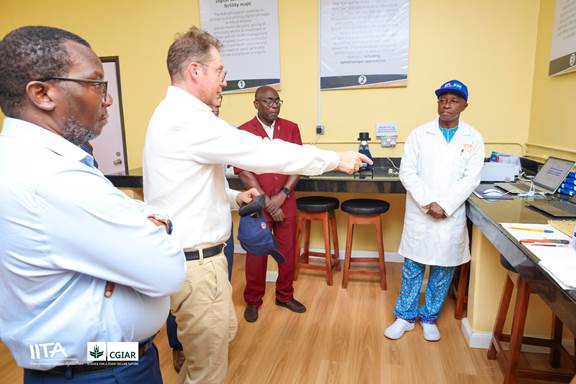
The garage analogy became tangible in the laboratory. Here, the tools behind the Hub’s model came into view: soil analysis, laboratory technologies, digital soil maps, field data and the expertise needed to connect them.
The laboratory combines newer technologies with traditional methods to analyze soil more rapidly and at lower cost. But the analysis is only the beginning.
Data generated from soil samples can be combined with terrain, remote sensing and other information to build digital soil maps showing how soil properties vary across landscapes. Those maps can then be brought together with weather data, field trials and crop modelling to understand how different soils respond to different nutrients.
The work draws on a substantial evidence base, including around 500 field trials conducted across five countries in 2025, alongside legacy data, digital soil maps and weather information.
This is where the Hub’s work moves from understanding soils to making decisions.
From 2025 till date, the team is using this combination of data and modelling to develop fertilizer recommendations for maize and rice in Nigeria, Ghana, Liberia and Sierra Leone. The recommendations are now being validated in the field before they are integrated into decision-support tools such as AKILIMO and linked to national systems.
The resulting models are beginning to show just how much fertilizer needs can vary across landscapes. For nitrogen alone in rice and maize for example, estimated requirements range from less than 20 to more than 140 kilograms per hectare across more than 10 million hectares in three countries (Nigeria, Ghana and Liberia) .
The implication is significant: a recommendation that works for one field may not be appropriate for another. The ambition, therefore, is to get closer to answering a useful question: What does this field need?
Standing in the laboratory, the connection to the Hub’s “garage” model became clear. The Hub is not simply assembling expertise for its own sake. It is building and maintaining the technical capacity that countries can draw on to answer practical questions about their soils, crops and fertilizer needs.
And ultimately, that is what turns soil data into something that matters: a better decision about what goes into the ground.